The days are getting much shorter now at Casey. After losing something close to one hour each week around the Autumnal Equinox (March 22nd), the rate of change is now slowing down so that 7 days from now we will have just 40 minutes less daylight than we do today. Come June 22 (the Winter Solstice) we will have just two and a half hours of light each day (presuming it isn’t cloudy).
  But for the most part we have been very lucky with the weather so far. For a few weeks after the ship left we had lots of low cloud, and not much sunshine, but generally light winds. A little way into March though, the cloud disappeared (probably went to somewhere like Mawson or Davis), and we were treated to two or three weeks of fine and sunny weather. The clear night skies here are great, and even better when you get to see something like this…


 As much as I like these photos however, I will admit that they give a somewhat warped idea of reality. While nothing can really compare to watching this light show in person, the necessarily long exposure of the camera, 40 seconds or more, definitely enhances the colour. To give you an idea, the snowy foreground was almost pitch black to the naked eye, but the camera picks up the colour very well.
 I must have stood outside (in –15C or so, which isn’t really that cold unless you’re standing still taking photos) for over an hour that night (I was excited), but the aurora itself actually lasted for 3 nights (albeit faintly). The third night of which Craig and I had decided to ski to Wilkes again.
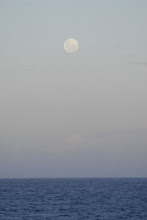
Although due to the shorter days we no longer have the luxury of choosing to travel at any hour of the day, we set off this evening after work and were aided by the recently full moon. By the by, you will have to wait another 10 years for a full moon on the Autumnal Equinox… for those who are interested.
 This was to be my second visit to the Hilton in a week – a place that for me is becoming a home away from home away from home… Whats more, it was to be my third jolly in as many weeks, after a trip to Jack’s Donga the previous weekend. Its hard to resist the only wood fire in all of the Australian Antarctic Territory.
  What I particularly like about visiting these huts is that it gives you an idea of what it was like for the real explorers… even if its just an idea. We live in such comfort and luxury that I can sit at my window in the evening, reading a book with a cup of tea, and 2 feet away, on the other side of the window, the temperature can easily be 30C or 40C lower and blowing 30 knots. If you forget how things freeze here, and how quickly you can get cold outside, visiting these huts if a nice reminder.
  We turn the bar-heaters in the huts off at night for safety reasons, and at Wilkes the fire will go out. Ventilation means that by the time you wake up in the morning the hut has more or less dropped to ambient outside temperatures (-10C or so), and it will be a while before it heats up again. But for us this is just one night in many, for Scott it was every night, and he didn’t have bar-heaters…
  But the wood fire isn’t all I like about Wilkes. It is, as I have mentioned before, a historical site, quite literally frozen in time.
In summer, this (above) was a shallow melt pond at Wilkes. A few inches bellow the surface are planks of wood, tin cans, metal pipes, and other bits and pieces. It’s a black and white photographer’s dream… and a nice place for a novice like myself to try shooting off a few too.
 My take on Wilkes is this: it was positioned terribly by the Americans, who seemed to have landed in Newcomb Bay and thought “right, where is the most snow accumulating, the most wind blowing, and generally the worst looking area?” and started building at Wilkes. They then got sick of digging the station out of the snow every time there was a puff of wind, and gave over power to the Australians.
  After about a decade (50s or 60s I think) they too got sick of it and decided to pack up and leave. No… wait a minute… they didn’t pack up anything, they just left! As I am going to do now. Arrivederci!
It’s a black and white photographer’s dream… and a nice place for a novice like myself to try shooting off a few too. My take on Wilkes is this: it was positioned terribly by the Americans, who seemed to have landed in Newcomb Bay and thought “right, where is the most snow accumulating, the most wind blowing, and generally the worst looking area?” and started building at Wilkes. They then got sick of digging the station out of the snow every time there was a puff of wind, and gave over power to the Australians. After about a decade (50s or 60s I think) they too got sick of it and decided to pack up and leave. No… wait a minute… they didn’t pack up anything, they just left! As I am going to do now. Arrivederci!
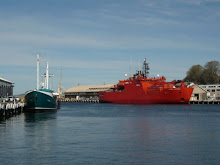
 Although the season feels distinctively like Autumn (in the Natural sense), for those of us left here on the ice, in a hominal sense, Winter has well and truly set in. Voyage 4, the Aurora Australis, our summer colleagues, and any contact with the outside world (at least physical contact) departed Casey on February 14th. Forgive the dramaturgy, I know it sounds extreme, but the day V4 left us was without a doubt one of the strangest days of my life! It’s a difficult thing to describe: that day, quite literally, 19 of us were deserted in a more or less lifeless place with the prospect of bitterly cold winds, blizzards lasting days at a time, at times constant total darkness, and were told, “stay here, we’ll be back in November”.
 As the last barge ferrying people from Casey to the ship slowly pulled away from the wharf, the reality of this finally began to sink in. I don’t think I’ve ever felt so literally deserted.
 Having said this, it wasn’t necessarily a sad or scary thing for me… more exciting than anything, which was a little surprising considering there were quite a few people visibly upset that afternoon. Many a tear was shed on the afternoon of the departure, but not before we on station gave the AA its customary send off: apparently flares make a regular appearance as the ship departs at the end of summer.
 One of our diesos, Brad, seeing off the AA on departure day.
 Once again the moon seemed to be in tune with the station mood just a few days later, rising auspiciously between partial cloud, marking the recent return of night-time to Casey. Now, almost a month later, we are experiencing around 12 hours without sun each day, and losing an hour or light each week. Things seem to be hastening to the darkness of the true Winter.
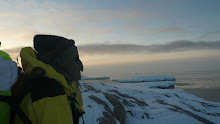
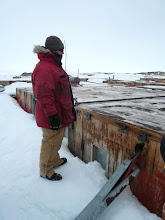
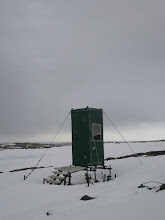
 The day after the ship left we had a Casey-wide day of rest, to mark the end of the busy resupply. It was a well-earned day off for many, who decided to kick their feet up for the first time in a while. But for some, a day of rest meant we could do what we came for… jolly. The indefatigable Todor, Curly, Doc and I decided a day ski trip to Wilkes was in order, so we donned the survival packs and went.

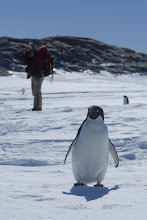
 Anyway, that’s probably enough of the old-fashioned grandpa in me… take a look at this photo of me and a penguin :)
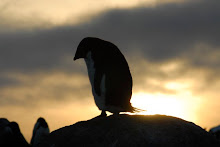
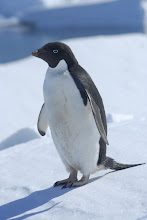
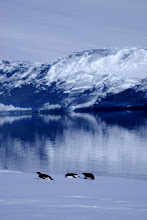
 Now, mid-March, most of the wildlife is starting to desert us. Pretty soon we’ll be the only life-forms silly enough to want to stay here, but for now there are still a few straggling penguins, moulting in preparation for their trip north, the odd weddell seal, and a few elephant seals south of Casey, who are all expected to head off within the next few weeks.
 [Aurora Australis at night from Casey]


 Essentially, resupply is about providing the station with enough food, fuel, material (plumbing, building, electrical supplies etc), and winterers’ cargo (the rest of mine and others’ personal luggage) to last until next summer. Bellow is the contents of one-of-five food containers on the floor of our Green Store, which I helped unload with the vested interest that it is to last us/Casey for another 12 months.
  As an extra however, there are often many A.A.D. (Australian Antarctic Division) head office employees, science related ‘round-trippers’, and others, who visit the stations on these voyages for various reason, and who have certain projects to complete during the Resupply week. I was assigned to accompany one such BoM employee on a trip to the Wilkins A.W.S. (automatic weather station) during this week, giving me a pleasant day away from the station.
 The only free vehicle at our disposal on station being the Noddy, (Latin name: Warpus speedus), at least 6 hours of our time was spent bouncing up and down therein. It was however one of the clearest, calmest, and most pleasant days of all time at Wilkins – and, being so, we enjoyed a very civilised alfresco luncheon of antipasto ingredients at the Antarctic Circle.


 We have 3 IRBs (Inflatable Rubber Boat) on station, and for most of the summer only two with a coxswains licence. For some over-precautious reason there is a law that states only coxswains may drive an IRB in Antarctica, and that there must never be only one boat in the water at a time. Since summer was quite a busy period, it was hard work finding an evening after work where both coxswains were free and nothing else was planned.
 Late in the season however, a 3rd coxswain arrived via the A319 Airbus, and on a very calm and clear evening late in January, we pushed some small bergy bits aside at the wharf, and put the boats in the water for the one solitary boat cruise of the season. One is better than none though, and I must say it was the most amazing 2 hours I’ve ever spent in a boat.

 The soft light, while adding to the beauty, and giving the night a surreal/other-worldly feel, hindered my photography a little. Having by no means mastered the art as yet, I found I was very frustrated with the photos I had taken when looking through them later. I do think a few turned out, but its always annoying to realise that the view other people will have of your experience falls so far short of reality.

 The main conglomeration of bergs lies around 15kms north of station, just off the coast, on a relatively shallow bank. Medium sized bergs seem to beach themselves here for long periods of time, meaning that we have a constant view of some pretty amazing bergs just to our north. Until now they have been tantalising us, but have always been just out of reach, so it was great to finally get in amongst them!


 I was lucky enough to get an ‘assistant’ seat in an IRB for one such trip, which again just happened to be on a crystal clear and still bluebird day… not a ripple on the water. This was a trip to Robbo’s Hut, sticking pretty close to a section of the coast that doesn’t have too many bergs around, but there was still the odd berg to be seen and photographed. Nothing like the berg cruise proper, but still pretty awesome all the same.