One thing that has taken up a lot of our time and thoughts here at Casey this summer has been the newly opened Hobart to Casey airlink. The airlink, which has been many years in the planning, made its first actual landing in Australian Antarctic Territory this season, and has subsequently made somewhere between 5 and 10 more since December’s inaugural.
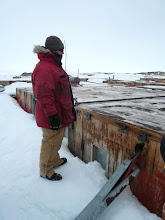
  The runway is some 70kms from Casey, and is situated up on the Antarctic plateau, essentially on a big sheet of ice that moves 10 meters seaward every year. There really isnt a lot up there to see - its a desert. Below we have Farmer Joel standing on the end of the 4km long runway.
 Nevertheless it is an interesting place to visit for a few reasons. A trip to the runway (I’ve done a few now for aviation observations at the aerodrome) means either a 2 hour bumpy hagglunds ride; 15-20 minutes in a CASA (plane);
  or around 4 to 5 hours in the ‘Noddy’ (zero to 10km/hr in a record breaking 25 minutes).
 On Friday, however, Todor is going to attempt the Wilkins to Casey trip using another mode of transportation. He is going to try skiing the 70km, with people sponsoring him per kilometre, and all proceeds going to Camp Quality. Id love to accompany him but unfortunately I have to work…
Whichever way you travel to Wilkins Runway you will pass into the Antarctic Circle. Casey lies at 66 degrees 17 minutes South, just north of the Circle which lies at 66 degrees 33 minutes South. Apologies, but a really lame photo at this point is a unavoidable…
 Once you actually get to the runway what you see is a whole heap of demountable type containers in a single line running north/south. The logic behind this is that the prevailing katabatic winds - caused by masses of super cooled air on the plateau running via gravity toward the sea - come from the east. In such situations wind scours build up on the eastern face of objects, while blizz tails build up behind the western face. Since the snowfall and average wind speeds are fairly high at Wilkins, the potential for container-covering blizz tails is quite high, therefore no object is ever left directly west of another.
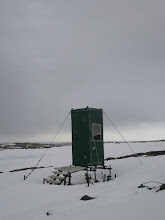
 A fluctuating crew of around 6 or 7 people have been living at Wilkins over the past 3 months, maintaining the runway, and if you ask me THAT is doing it tough. We are living like spoilt royalty at Casey! Below is their toilet/shower container, which is not attached to their living quarters, so in an 80 knot blizzard you would reeeeeally want to save up those number one's and two's.
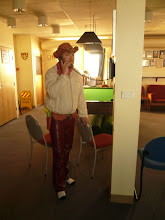
But despite all the hardships, the guys at Wilkins have been good enough to construct a lovely Arrivals and Departures lounge for airbus passengers. I think they call it the Quantas Lounge.
Oh, and for anyone wondering, yes, the runway is made of ice… they land an airbus on ice! However it is covered with a layer of compacted snow prior to every landing, and apparently has the breaking coefficient of a wet tar runway… I think someone is having a lend. 
 In any case, after a very busy few weeks with airbus flights bringing some 30 more scientists and the like to station, I think everyone is looking forward to the last flight on the February 1. After this it will be only another week or so before our much anticipated resupply ship arrives (Voyage 4) taking with it all of our summer crew and leaving just 19 of us here for some 8 or 9 months bondage… bring it on!

 Ive already said that, besides people, the thing I miss the most about living in Antarctica is the stars, and the night time in general (having so far only spent summer here). Two other things I miss are the rain (we’ve had some veeeery light rain, which was probably just sleet, but no serious rain drops) and sandy beaches (not surprisingly). While im not yet sure how I can add photos in to illustrate this, I thought I might take some time here to mention some other peculiar ‘things’ about living at Casey that people might otherwise take for granted.
 (this photo is of no significance except to keep things remotely interesting for you)
 (Candy Boy and Pup: Everyone seems to get a nickname here, which is more of a trady thing than an Antarctic thing I think, but Sean somehow got Candy Boy, and I got Pup because im the youngster).

 From Jack’s Donga and the moraine line the terrain drops away steeply towards the sea, where fast-ice (sea-ice that is still attached to the shoreline) is caught and stays for much of the summer. The result is that Jack’s has a great panoramic view of some pretty serious bergs.
 Jack’s Donga is only some 15kms away from station, but when youre living thousands of kms from any other civilisation, I must say, being 15kms away from the comforts of the Redshed is quite a liberating experience. Spending the night here with one, two or three others is a great way to chill out and get some serious down-time.
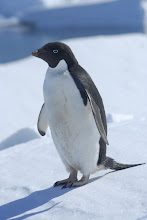
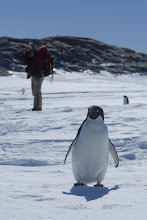
  In fact, while doing exactly this, sitting on the rocks of the moraine line, I remember looking down toward the sea-ice below (almost one km away), and seeing a vanguard of around 30 Adelies marching across the ice. Slowly I saw them change their direction from cutting across our path to coming directly up the hill towards us. I don’t know how they saw us sitting there (maybe it had something to do with our fluoro yellow jackets), but from about 1 km away they changed direction, walked up a 40 degree slope straight to where an eager Todor was waiting with camera in hand, stayed for a few minutes to examine us, then walked another 20 meters, changed direction, and turned back to their original course. That’s quite a detour for an animal that doesn’t have knees. My point is theyre curious!


 The Antarctic summer has surprised me, it’s much more summery than I had imagined actually. On still and sunny days I have even sat outside on the Redshed porch sunbaking, sans t-shirt! Its not all good though, The Melt is making life difficult for anyone wanting to go on jollies. Skiing to Wilkes for the night might become the only option for the rest of the summer. There have been several minor quad boggings while on jollies, and one on a recent trip to Wilkes was so well bogged it resulted in a call to station for a hagglunds to pull it out (far bellow). After wading around in thigh-deep water trying to get it out I decided I’ll be more accepting of cold water in the surf from now on.
 A few days later we had a hagglunds seriously bogged in the same place, which took two attempts and our big Challenger to retrieve.
 Trips to Shirley Island have now stopped (late December), but I was lucky enough to get across one last time just as the chicks started to hatch! Its an amazing thing, but the eggs of the whole extended colony will all hatch within 1, 2 or maybe 3 days of each other. Im told the hatching can be predicted almost to the day each year, and is always around the time of the summer solstice (December 21).
 I have to say I was pretty blown away by the few chicks that I did get to see. Seeing the adults feeding the young ones was great, because you know how long they’ve been sitting/laying there on the egg waiting for it to hatch. I also saw one chick trying to break out of its egg, with the mother/father helping, but those photos didn’t turn out as well as I had hope.
 The whole thing was pretty amazing. It makes you wonder whether the penguins realise what is inside their eggs, or whether it is just an instinct to sit there, or whether they know when the egg is getting close to hatching. Theyre very protective, thats for sure, but some who have lost their egg (probably to skewers) will often sit on a large egg-shapped rock.
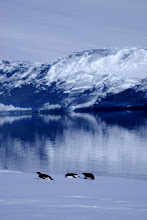
 There is still a small bridge of ice to Shirley now, but it is very thin, and receding. I wouldnt like to be trying my luck getting across. Its a very different island now though than when I first saw it 2.5 months ago! The receding sea-ice has now exposed some spectacular ice-cliffs nearby: within the recreation area and close to Shirley. The photo below shows 6 black dots (penguins) waddling on the edge of these cliffs.
 With Shirley now out of bounds we have started making more use of the recreation area for our short walks and afternoon jollies. The area isn’t large, but its big enough to get out of sight of station if that’s what you want, and there are some nice areas such as the old Casey Station and wharf areas, which penguins and seals often visit.

 While not everyone is into hiking within the rec area I have a few good friends who really enjoy it. Below are 2 summer-only expeditioners, Jenn and Sean (aka Candy), who I'll definitely miss once the last ship leaves in mid Febuary.
 And what would any weather observer's blog post be if it didnt include a few funky photos of clouds? The first photo below features our sun gauge. The sunlight passes through the glass ball and is concentrated enough to burn through the highly sensitive card, which we replace every day.
 Being only 2.5 months into my 1+ year stay here im not sure if I am actually allowed to say I miss anything yet, but apart from my Eb, my family, and my friends, if there was one thing I would say I miss right now it would be stars... I havent seen them for about 1.5 to 2 months! It may not sound like long, but it must just be one of those things we take for granted. I think my opinion of them may change over winter however, i'll keep you posted, albeit irregularly.
 Field training, as I mentioned, prepares us for travelling off station on jollies by teaching us “vital skills, essential for travel within Antarctica”. Most of what we were taught is common sense or skills most people should already know (navigating by compass, how to set up a tent, how to light a gas stove), but as usual it seems to be more about making us accountability for our actions than anything. Having said this we did learn some interesting things; things it is pretty hard to learn elsewhere, like ice-walking with instep cramp-ons, bivvying in a near blizzard, and sea-ice travel.
  As tame as that slope looks, its hard to explain just how slippery a hill of ice really is. I actually took a tumble or two, which may or may not have been intentional.
  Our main mode of transport for jollies is quad bikes. They work surprisingly well on snow, and absolutely terribly on ice… what a surprise. But that doesn’t mean they aren’t still great fun.
  Here we are travelling on a large piece of sea-ice (above). The recommendations for ice thickness in terms of sea-ice travel are 20cms for pedestrian travel, 40cms for quad bikes, and 60cms for a hagglunds. I tend to err on the side of caution with these figures, maybe its just me, but I like the concept of self-preservation.
  We hand-drill down to test sea-ice thickness every few hundred meters.
 Removing the snow that built up around the buildings just got too much so they gave it to the Australians, and we relocated it. Wilkes is an interesting time warp because all that’s left is the tops of the old buildings (buried under snow) and lots of random ‘junk’ like broken wooden crates, rusty nails, old metal pipes, which must be left in place since the whole area is now heritage listed.
  However the main reason people visit Wilkes from Casey is to stay at the “Wilkes Hilton”. This is an authentic Antarctic building (built in the early 50’s), which contains the ONLY wood fire on Australian/Antarctic land. Of the 3 or 4 ‘field huts’ people from Casey can visit on jollies this is the most luxurious… hence the name.
 Despite the 4 beds inside however, we bivvied out this night as part of our training. A bivvy bag consists of a windproof sack (a little bigger than a sleeping bag) with a foam mat rolled up inside. The idea is that if you get stuck in the field and the weather closes in, it may be safer to stay put and wait for help or the weather to clear, which may be 2 or 3 days... Bivvying is a warm and dry alternative to standing around in a blizzard.
  That techni-coloured blob is actually one of our plumbers, Wayne, inside his bivvy.
 When you bivvy everything goes in. There isnt too much room, and its hard to organise things in a stong wind, but once youre sorted its ok. Of course, where every other field training party had warm nights and no wind for their bivvying, we had 25-30 knots and blowing snow. But despite all this I slept quite well that night, and had to be woken up the next morning.
 The next day we ate lunch in what is intelligently called a mega-bivvy (above). In 15 knot winds 5 of us climbed inside and got very warm very quickly. This too is simply a windproof sack with no structure to it, but within 5 minutes our own body-warmth had expanded the bivvy so that we had plenty of room inside.
 Our second night was spent on the Mitchell Peninsula, 15kms or so from station as the albatross fly’s. The infrastructure here consists of a small caravan type hut, and three polar pyramids. Polar pyramids are more or less bomb proof tents… at least blizzard proof… and are designed such that they become more sturdy in stronger winds.
 Sleeping in these pyramids with the sound of light snow falling outside was the closest ive felt to home and camping since arriving.
 We covered quite a few other things in training, but for fear of boring you to tears I might once again say adios. Until next time.