Its now been just over a month since my last post, and already we are getting about four hours more sunlight in our day than we did back at midwinter.  However July was an incredible month in terms of weather! Below you can see just one of many wild sky days we've had recently. These are a type of cumulonimbus cloud, usually associated with the tropics, and very rare for anywhere in Antarctica. The almost look like huge huricanes.

 To give you an indication of what I’m talking about, 17 of the 31 days gave us winds of over 100km/h, while 9 or so of those were over 135km/h. We also had 8 blizzards in July, where the nearest rival month for the year (thus far) has been June, with just four.
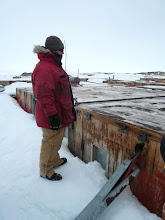
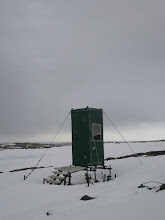
 The photo above was taken about 20m from our Operations building where I work. The photo below more like about 30-40m from the same building. You can just make out the blizz-lines that extend between each building, and you can probably guess why we have them...
However July was an incredible month in terms of weather! Below you can see just one of many wild sky days we've had recently. These are a type of cumulonimbus cloud, usually associated with the tropics, and very rare for anywhere in Antarctica. The almost look like huge huricanes.To give you an indication of what I’m talking about, 17 of the 31 days gave us winds of over 100km/h, while 9 or so of those were over 135km/h. We also had 8 blizzards in July, where the nearest rival month for the year (thus far) has been June, with just four.The photo above was taken about 20m from our Operations building where I work. The photo below more like about 30-40m from the same building. You can just make out the blizz-lines that extend between each building, and you can probably guess why we have them...But despite the oppressive weather (or perhaps in spite of it), and the darkness that dominated our days for the months surrounding mid-winter, some of us still found it necessary to get out as much as possible.
On certain big blizzard days parts of the station become trouble areas. Above you can see how fine snow particles (blizz) can even get in through a cold porch door. And below you can see how difficult it can be to release a balloon sometimes. It may not look much, but the snow line past the doors is almost as high as my chest! (although, tis true, im not the tallest guy going around)
I really appreciate having Shirley Island ‘open’ again now that the sea-ice has thickened up between it and the mainland, because it has some interesting hills and features to explore for a couple of hours on a short mid-day walk, which is something you really look forward to seeing at times, especially when the all too familiar station surrounds becomes a bit monotonous. No animals are there now or course, except the occasional seal stretched out on the sea-ice, but its still very refreshing to get ‘out of town’ (so to speak) for a while. Walking on sea-ice can often look much like walking on solid land when its littered with bergy bits like this.
 I also really enjoy being able to ski or walk to Wilkes and back, even if it’s just for a day trip. A few weeks ago, close to mid-winter, I left station on one of these hikes (with Todor, Craig, and our station leader, Bob) not long after sunrise and stopped briefly at Wilkes Hilton to ‘de-blizz’ the entrance and thaw out with a cuppa. Then Craig and I turned back to station, in a race against the fading light, while Tod and Bob stayed on for the night.
Below is something you get used to when visiting huts. Especially Wilkes.
Walking on sea-ice can often look much like walking on solid land when its littered with bergy bits like this.I also really enjoy being able to ski or walk to Wilkes and back, even if it’s just for a day trip. A few weeks ago, close to mid-winter, I left station on one of these hikes (with Todor, Craig, and our station leader, Bob) not long after sunrise and stopped briefly at Wilkes Hilton to ‘de-blizz’ the entrance and thaw out with a cuppa. Then Craig and I turned back to station, in a race against the fading light, while Tod and Bob stayed on for the night.Below is something you get used to when visiting huts. Especially Wilkes.
I’ve since been on a few such hikes/skiing trips to Wilkes, and definitely think it is one of the best activities you could possibly do here.
Doesnt get much more intrepid! Dom, Tom and I in front of the Wilkes Hilton.

Curley, Dom and Tom. We've found that one of the easiest ways to carry our survival packs (something you must have every time you leave station limits, and which isnt that light) is to drag them in sleds.
 There’s nothing like cranking up the Wilkes fire and cooking a beautiful wood-fire pizza at The Hilton after a good hike from station!
Whenever we plan one of these skiing trips something inside me is always a little (stupidly) hesitant to strap on the skis, don the survival pack and leave the safe and warm confines of Red Shed decadence, but I always manage to convince myself that I should, and I can tell you I’m never disappointed! And it’s not just getting away from the same 100m by 500m patch of ice, rock and snow that I have spent the past 9 months on (almost exclusively) either. Its difficult to explain what is so energising about getting out into the “wilderness”, but it certainly re-invigorates the senses in a way, and feels great to do some proper out of doors exercise for a change.
Here is a distance shot of the Vandaford Glacier (above). The way it is lit here exemplifies how Casey seems to be often covered by a layer of low cloud, while just 30km south or 30km north appears to be enjoying clear skies and sunshine.
Here is a shot taken from the "bedroom" at Robbos Hut. Not a bad vista.
We have a running machine, an exercise bike, a rowing machine, and all sorts of weight lifting gizmos, which aren’t really my thing, but I try to go for a walk or jog on the runner when I can, to get some blood flowing. It’s hard to do much else when the wind outside is over 200km/h, or the temperature is below –30 degrees… two of the more extreme weather circumstances we have endured at times over the past month or so. Below is a shot of me standing against just a 60 knots wind. It may not seem like a huge angle, but try it when theres no wind and you'll see you wont get far. Well there you are. Sorry it takes so long for me to update my goings on, I know that for the most part it’s the only way you get to see photos and hear what I’m up to (since I’m so hopeless at calling regularly), but one of my problems is that as time goes on the aspects of living here that seemed significant to me 7 or 8 months ago almost seem normal now. It’s a trap I have to remind myself not to fall into because talking to different people back home I realise how little people actually know about the place, just as I knew so little about it before I arrived. I was talking to nan a while ago and she asked “isn’t it all ice that you’re walking on? Don’t you slip over all the time?” It was a very good question because 99% of Antarctica is covered by ice, but a lot of the ice is covered by compacted snow, which is not slippery. However there are plenty of clear patches where snow does not fall or is blown away and you’re left with several hundred metres (even more as you head inland to the middle of the continent) of pure ice on top of the bedrock, which is far below. Trapped air and other particles means that you can’t see further than half a metre or so into the ice in most places, but on these parts you certainly can slip over, easily. But Casey is very coastal, and situated on a small peninsula, a few hundred metres past the edge of the ice which covers the rest of the continent. So Casey is built on a small hill of rock surrounded by shallow valleys, which are permanently covered by compacted snow. Confused? Sorry, it’s difficult to explain.
Well there you are. Sorry it takes so long for me to update my goings on, I know that for the most part it’s the only way you get to see photos and hear what I’m up to (since I’m so hopeless at calling regularly), but one of my problems is that as time goes on the aspects of living here that seemed significant to me 7 or 8 months ago almost seem normal now. It’s a trap I have to remind myself not to fall into because talking to different people back home I realise how little people actually know about the place, just as I knew so little about it before I arrived. I was talking to nan a while ago and she asked “isn’t it all ice that you’re walking on? Don’t you slip over all the time?” It was a very good question because 99% of Antarctica is covered by ice, but a lot of the ice is covered by compacted snow, which is not slippery. However there are plenty of clear patches where snow does not fall or is blown away and you’re left with several hundred metres (even more as you head inland to the middle of the continent) of pure ice on top of the bedrock, which is far below. Trapped air and other particles means that you can’t see further than half a metre or so into the ice in most places, but on these parts you certainly can slip over, easily. But Casey is very coastal, and situated on a small peninsula, a few hundred metres past the edge of the ice which covers the rest of the continent. So Casey is built on a small hill of rock surrounded by shallow valleys, which are permanently covered by compacted snow. Confused? Sorry, it’s difficult to explain.In these two photos you can see how the snow (and ice below) slopes down to the coast, and the Bailey Peninsula on which Casey sits.
It’s small things such as this that after 9 months seem quite normal to me. But since the dead of winter has provided much fewer opportunities to get out and explore, due mainly to the lack of light, I have found that a large part of being here at this time of year is about the other people I am living with (relationships and interactions). This however wouldn’t make for terribly interesting reading, and doesn’t afford too many great photographic moments, so I will continue to get out as much as I possibly can – a prospect which is looking brighter (ho ho ho) every day as the light returns.
But if I may continue on a theme for a moment… I don’t remember previously showing this… here is Robbos Hut's entry into the Toilets of the World competition.
But if I may continue on a theme for a moment… I don’t remember previously showing this… here is Robbos Hut's entry into the Toilets of the World competition.

This leaves just the Browning Hut loo to complete the full set. Stay tuned.

 Hello again. Mid-winter’s day is a huge milestone in Antarctic life, as I have said before, and if there is a particular day worth celebrating here you feel this is it. For all that mid-winter means to me back home, I’m sure I will always think of Antarctica at this time of year from now on – of the people who are here, and the people who have wintered here before. After some rough calculations we figured the total number of people on the continent during the 2008 winter would be less than 1000, and that the total number of people who have ever wintered here would be less than the number of people an average AFL match draws to a stadium. Amazing when you think that Antarctica is actually twice the size of Australia (not including the area covered by sea-ice during the winter months)! So on days like mid-winter’s day you feel pretty lucky to be here, and that it’s something worth celebrating. But celebrations are only what you make them, and it was up to us to make the day enjoyable, so here is how we did it:
 We started the day with an extravagant morning tea, which included plenty of pastries, fruit salad, muffins, and a large selection of “smoko” bowel-clogging stuff. It may not sound like much, but considering morning tea usually consists of a biscuit and a cup of tea, this was a big hit with the “tradies” on station. Unfortunately I have no photos of this, but you can probably get an idea just by looking at the photos of our mid-winter’s dinner, below.
 It was all quite a drawn out process. Only one person was to go in at a time, and they were to be attached to a rope via a harness for safety reasons (down here we are frequently restricted by OH&S red tape). As I am part of the medical team I was to be present during the whole process, but all the time standing around waiting meant I lost a lot of feeling in my fingers and toes (something you get used to here).
  It was interesting to watch people’s reactions to the cold water. Once in, it took most people a good few seconds before they could stop making shivering sounds and start talking, and even then words were few and far between. I promised myself that when I went in I wouldn’t make any shivering sounds, but I found that in truth I really didn’t have much control over what sounds I made.
 I also noticed that nobody really smiled while they were in the water, but conversely, once they were out, they couldn’t stop themselves from smiling. Before the swim I had only planned on going in up to my waist, but once in that far I felt the water wasn’t as cold as I had expected, and so I went under.
 Despite my hair freezing in the –22 degree air temperature within minutes of my getting out, my fingers and toes were really the only parts of me that needed warming, and for that we had a heated shipping container nearby.
 After the swim, a number of us chose to relax and warm up in the spa, which had been specifically placed just in front of the Red Shed for the day (another Casey tradition on mid-winter’s day). With a water temp of around thirty-eight degrees, and an air temp of around minus twenty, we had a temperature difference of fifty degrees between head and body!
 As you can see from Tod’s photos, steam from the water settling in our hair made for an amusement afternoon spa, during which we all ages about fifty years.
 The mid-winter dinner is a huge part of the day’s festivities, and something the chef works very long and hard to make special.
 As you can see, for 19 people the quantity of food was totally ridiculous, but given the only fresh produce came from our meagre hydroponics facilities, the quality was first rate, and something everyone appreciated.

 This is a time when several speeches are made. Anyone can make a speech, or toast, but after putting together both a formal and an informal invitation for people to send out (to friends, family, loved ones, celebrities, members of parliament etc etc), I was asked to read out some of the more interesting responses received, and toast to those people who would like to be here, but couldn’t be. I included in this a response I received myself from a friend (who shall remain nameless), in which I was worried he had actually bought himself a ticket to Hobart and was waiting there for instructions on how to catch the next flight to Casey. It was a good reminder of how little people know about this place, and how lucky I am to be here.
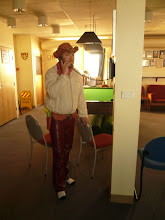
 Usually, people dress very well for the mid-winter’s dinner (this generally means suit and tie), which was something I didn’t know of until I got here, so I had to make do with what I could find in the station props room.
 I played the part of a puppet in a stage-adapted version of Team America, which people were kind enough to say they enjoyed.
 To finish the night off Casey’s newest rock band, Comfy Chair, played a few songs in the wallow, which I believe was also received very well, probably due to the fact that people miss seeing live music more than the quality of the performance… but we had fun nevertheless.
 In the end, mid-winter’s day for us here was always going to be whatever we made it. I think most people did something to contribute to the festivities in some way, and consequently we had a great time. It was a good way to celebrate the ‘mid-point’ of the year, the shortest and darkest day, and the return of the light.

 Sunset... 1:50pm

 We’re just a few days from the mid-winter solstice, and the sun has travelled more or less as far north as it is planning to for the entire year. Soon it will begin to move south again, and the seemingly eternal night will retreat south of Casey as daylight hours return. Instead of rising in the far north north east and setting in the far north north west, the sun will start to rise from a more easterly position, and set further to the west.
 Midday sun over Casey